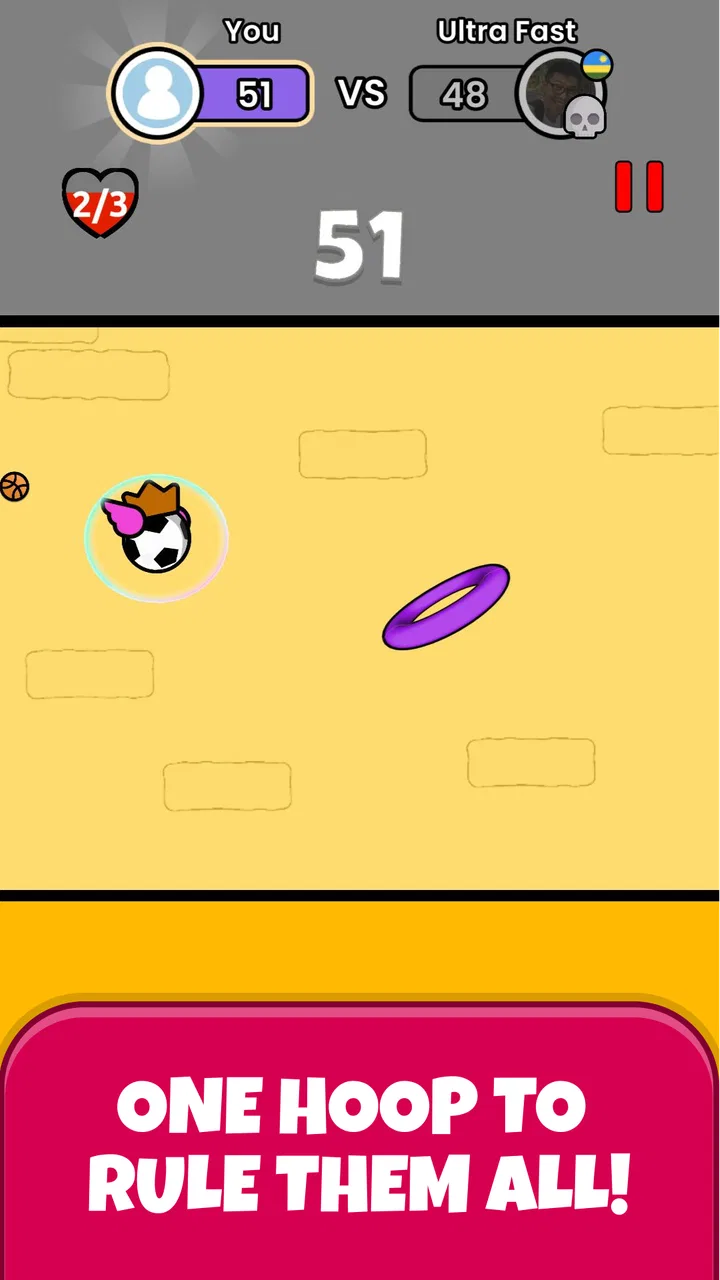
Flappy Dunk
- 4.5
- Rating
- 10.00M
- Installs
- Free
- Price

 Analysis by App-foxy
I downloaded Flappy Dunk expecting a quick arcade distraction, and that is exactly where it works best. The idea is easy to understand: guide a basketball through hoops with one-touch controls, keep the rhythm going, and try to extend the run before a mistake ends it. That simplicity makes the first few sessions unusually inviting. I did not need a tutorial-heavy introduction or a long explanation of rules; I could start playing almost immediately and understand what the game wanted from me.
What surprised me was how quickly a basic tap became a timing exercise. The challenge is not simply pressing at the right moment once. I had to watch the ball’s movement, anticipate the next hoop, and avoid tapping too early when I was trying to recover from a poor angle. It feels closer to managing a short sequence of reactions than to playing a traditional basketball game. That distinction matters because people looking for teams, matches, or realistic sports controls may find this too narrow, while anyone wanting a compact reflex game will understand its appeal within minutes.
Why the first week feels so satisfying
The opening appeal comes from the clean relationship between action and result. One tap produces an immediate change, and a successful dunk gives enough feedback to make another attempt feel worthwhile. I found myself restarting after mistakes not because each round was long, but because the next attempt always seemed capable of being better. That is a powerful structure for short breaks: there is no need to reserve half an hour, remember a storyline, or coordinate with another player.
You May Also Like

 Blood Strike: 2.5 Anniversary
Blood Strike’s Loadouts Turn Every Drop Into a Tactical Gamble
A close look at Blood Strike’s custom loadouts: how fast access to signature weapons reshapes its battle royale rhythm, rewards preparation, and narrows the gap between fights.

 Pandora - Music & Podcasts
Pandora’s Music Is Easy to Start, but Harder to Recover
Pandora’s strength is its low-effort path from a seed to a station. Its weak spot is how much confidence it asks you to place in connection, setup, and quiet recovery.

 8 Ball Pool
 Is Built on Rivalries, Rematches, and Routine
A close look at the rivalries, rematches, shared routines, and unanswered safety questions that turn a quick pool match into a persistent mobile community.

 Samsung Music
’s Quiet Strength Is Playing What You Already Own
Its reach comes less from spectacle than from dependable access to a personal library. That simplicity is both the app’s strongest retention engine and its ceiling.

 AccuWeather: Weather Radar
AccuWeather Review: A Quick, Clear Forecast for Everyday Decisions
For everyday plans, the best forecast is the one you can understand quickly. AccuWeather makes rain timing, radar, and local conditions easy to act on, with a few trade-offs.

 Hill Climb Racing
Why Hill Climb Racing Still Turns Crashes Into One More Run
A tiny car, a bumpy hill and one more upgrade: Hill Climb Racing keeps resurfacing because its simple chaos makes every near-miss feel personal.
More From Our News Desk



During my first week, I used it in the situations where many people reach for a small arcade game: while waiting for an appointment, during a short commute, or when I wanted something more active than scrolling. A round can be treated as a single attempt, so putting the phone away does not feel like abandoning a large task. The game is especially suitable for players who enjoy chasing personal improvement rather than collecting a large amount of content.
The controls are accessible, but accessible does not mean effortless. The early attempts teach the basic rhythm naturally, while later attempts expose small timing errors. I noticed that frantic tapping was usually worse than deliberate tapping. A useful adjustment is to watch the ball’s relationship to the hoop rather than staring only at the ball itself. Once I began reading the space ahead of the ball, my taps became less reactive and my runs felt more controlled.
That is one of the first non-obvious lessons here: the game rewards a calm visual routine. I would look at the current arc, identify where the next opening was likely to be, and tap with the next movement in mind. This does not turn it into a deep simulation, but it does give the simple format a small layer of technique. Players who treat every miss as random may tire quickly; players who examine why the miss happened have more reason to return.
The presentation also helps the first impression. Flappy Dunk is a game from VOODOO, a developer associated with quick-to-learn mobile arcade experiences, and its identity is easy to grasp without a complicated interface. It is free to download and carries an Everyone content rating, so it is broadly approachable for casual players and families. The important practical point is that its low barrier does not require a commitment before you know whether the central mechanic suits you.
Who will enjoy the opening sessions
I would recommend the first-week experience to anyone who likes score chasing, short reaction tests, and games that can be understood while standing in a queue. It is also a good choice for someone who wants a basketball theme without the management, rules, and match length of a full sports title. The hoop gives each attempt a clear visual target, making the action feel more purposeful than tapping through an abstract obstacle course.
It is less suitable for a player who needs constant novelty. The core activity remains focused on the same basic interaction, so the fun depends on whether improving timing is satisfying enough on its own. It is also not the right pick if you want a career mode, opponents, realistic physics, or a social league. Those expectations belong to a different kind of basketball game, and Flappy Dunk does not need to imitate them to be effective at its own scale.
One practical tip is to play with a consistent grip. I found that changing between one-handed play and two-handed play made my taps less predictable, especially when I was already trying to recover from a difficult approach. A stable posture is more useful than playing faster. For a game this sensitive to timing, even small distractions can feel like difficulty spikes, so it is worth treating each attempt as a brief focus exercise rather than background entertainment.
What remains after the novelty fades
The more important question is what happens after the first burst of curiosity. Many minimalist arcade games are enjoyable for an evening and then disappear from the phone. Flappy Dunk has a chance to last longer because its central loop is easy to restart and difficult to master perfectly. I could return after a break without relearning controls, yet still feel that better timing might produce a stronger run.
That recurring value is narrow but genuine. The game does not need to provide a new story chapter or a new ruleset every time I open it. Its value comes from offering a small, repeatable challenge that fits into spare moments. For me, that makes it more useful as a habit game than as a main game. I would not plan an entire evening around it, but I could see keeping it available for short mental resets.
The distinction between a habit and a routine is important here. A routine can be helpful when the game gives you a clear reason to return, such as practicing a particular timing pattern or trying to beat a previous result. A habit becomes less healthy when opening the game is automatic and every miss simply triggers another restart. Because the rounds are compact, it is easy to play longer than intended without feeling that much time has passed.
My best long-term use would be to set a personal stopping point before starting. For example, I might play a small number of focused attempts, stop after reaching a satisfying result, and come back later. That approach preserves the feeling of a challenge instead of turning the game into endless tapping. The short format supports this kind of self-imposed structure, even though the game itself does not need to provide a formal schedule.
Its audience size suggests that this simple formula has broad appeal. Flappy Dunk has an average rating of 4.5 from around 225 thousand ratings and has passed 10 million installs. Those figures do not prove that every player will enjoy it, but they do match my impression that the basic control scheme is easy for many people to pick up. The stronger question is not whether it is approachable; it is whether your own enjoyment comes from repeating a skill test.
How it compares with other arcade choices
Compared with a conventional basketball game, this is far less demanding in terms of time and attention. You do not need to learn a roster, understand a full set of rules, or manage a match. That makes it better for a quick break, but worse for anyone seeking strategic variety or a sense of progression through a sporting world. The basketball theme is a frame for the reflex challenge, not a promise of a complete basketball experience.
Compared with other one-touch arcade games, the hoop gives the action a more readable objective. I always know what I am trying to pass through, and the visual language makes successful timing feel physical. The trade-off is that the basic mechanic can become familiar sooner than a game that changes its obstacles more dramatically. If you prefer constantly changing puzzles, a broader arcade collection may hold your attention longer.
Flappy Dunk also differs from puzzle games because failure is mainly about timing rather than planning several moves ahead. It differs from endless runners because the player’s attention is concentrated on the ball and hoop relationship instead of steering through a wider field. These comparisons helped me place it correctly: it is best as a focused reflex toy, not as an all-purpose mobile game.
Another useful comparison is with competitive online games. Flappy Dunk is much easier to enter because there is no need to wait for a match or worry about another player’s skill. That makes it comfortable when I have only a few minutes. On the other hand, it cannot provide the social tension, teamwork, or unpredictable human opponents that make multiplayer games compelling. Choosing it means choosing solitary repetition over shared competition.
Monthly value and the work of keeping it enjoyable
After the initial novelty, the game’s maintenance burden is low in one sense: the controls are simple enough that I can return after days away and immediately remember what to do. I do not have to maintain a complex account, memorize a large system, or rebuild momentum through lengthy sessions. That makes it unusually forgiving as a casual app. If I want a quick attempt, the game is ready for that purpose.
The burden appears elsewhere. I have to maintain my own interest because the repeated action can feel similar from one session to the next. The game does not become more valuable merely because it remains installed. Its place on my phone depends on whether I still enjoy refining timing, chasing a better result, or using it as a short break. If those motivations disappear, there is little reason to force a daily routine.
Version 2.14 is the current version, and the game supports devices running Android 8.0 or later. For someone deciding whether to keep it installed, that makes compatibility worth checking before downloading, especially on an older phone. The game is free, although in-app purchases range from $0.99 to $214.99 per item. I would approach those purchases carefully and decide in advance whether the free experience already provides enough value for my needs.
The presence of optional spending changes how I evaluate a free arcade game. I do not need to pay to understand the core appeal, which is important because the central mechanic is simple enough to judge quickly. At the same time, anyone who is easily drawn into small repeat purchases should set a firm boundary. A short-session game can make spending feel harmless when each individual decision seems minor, so awareness matters more than the game’s low entry price.
For parents, the Everyone rating makes the content broadly accessible, but I would still explain the purchase model before handing over a device. The main concern is not the basketball theme or the control scheme; it is making sure a child understands that a free download can still include paid items. That is a practical conversation worth having with any game that offers purchases, particularly one designed for repeated short sessions.
Where fatigue starts to appear
The first source of fatigue is repetition. The one-touch design is the reason the game is immediately playable, but it also sets a ceiling on mechanical variety. Once I understood the basic timing, the remaining challenge depended heavily on how much I cared about improving execution. Players who need new environments, objectives, or character systems may feel that the game has shown most of its hand early.
The second source is frustration after an error. A miss can feel deserved when I know I tapped too soon, but it can feel less satisfying when I am not sure what caused the failure. My solution was to slow down mentally and treat a few attempts as observation rather than score chasing. If I kept restarting in irritation, the game became noisy; if I paused to identify the timing problem, it remained useful.
The third issue is that short sessions can encourage automatic repetition. The restart loop is convenient, but convenience can become monotony. I found it more enjoyable when I alternated between focused attempts and longer breaks instead of trying to grind improvement continuously. This is a small but important trade-off: the game is strongest when it occupies spare time, not when it is asked to fill all of it.
There is also a difference between difficulty and depth. A game can be hard without offering many different decisions, and Flappy Dunk often sits in that space. Its challenge comes from precision and consistency rather than from a large strategic system. That is not a flaw for a reflex-game fan, but it is a limitation for someone who wants each session to teach a new concept.
My long-term verdict
After considering both the first-week appeal and the month-to-month value, I see Flappy Dunk as a good small game rather than a complete long-term destination. It earns space on my phone when I want a fast, readable challenge that I can start and stop without preparation. The basketball presentation gives the tapping a clear purpose, and the timing loop has enough precision to reward calmer play instead of random attempts.
I would keep it installed for a friend who enjoys personal score goals, quick arcade rounds, and learning a simple mechanic through repetition. I would also suggest it to someone who wants an alternative to a full basketball simulator during short breaks. The free entry makes trying it straightforward, and the Everyone rating keeps its audience broad. Its strongest quality is that it respects a short amount of time while still asking for genuine attention.
I would skip it for a player who wants a lasting progression system, rich basketball strategy, multiplayer rivalry, or a steady stream of new activities. I would also skip it if repetitive tapping tends to become frustrating rather than satisfying. In those cases, a deeper sports game or a puzzle title with more varied decisions would offer better long-term value, even if it required more time to learn.
My final recommendation is to judge it by the kind of space you want it to occupy. Do not install it expecting a basketball career or an endless supply of surprises. Install it as a compact reflex challenge, try a focused handful of attempts, and notice whether improving your timing feels rewarding. If it does, the game can remain a pleasant companion for waiting rooms and short pauses. If it does not, its novelty will probably fade quickly.
Flappy Dunk earns lasting space only when its simplicity matches your habits. In my experience, that is the honest appeal: it is easy to pick up, quick to revisit, and precise enough to make improvement feel real, but it will not disguise a limited core loop with unnecessary complexity. As a free arcade game from VOODOO, it succeeds on those modest terms, and I would recommend it to the right player rather than to everyone.
FAQs for Flappy Dunk
01What is Flappy Dunk and how do I play it?
Flappy Dunk is an addictive arcade game where players control a basketball with wings, guiding it through hoops by tapping the screen to keep it airborne. The objective is to score as many points as possible by successfully passing through hoops without crashing. The game combines elements of Flappy Bird with basketball, offering a unique and challenging gameplay experience.
02Is Flappy Dunk free to download and play?
Yes, Flappy Dunk is free to download and play. However, the game contains in-app purchases and ads. Players can choose to purchase additional features or power-ups to enhance their gameplay experience. If you prefer an ad-free experience, there may be options to remove ads through in-app purchases.
03What are the main features of Flappy Dunk?
Flappy Dunk offers several engaging features, including multiple challenging levels, various basketball skins, and customizable wing designs. The game also features a leaderboard where players can compete against friends and other players worldwide. Additionally, there are daily challenges and achievements to keep the gameplay fresh and exciting.
04Can I play Flappy Dunk offline?
Yes, Flappy Dunk can be played offline, making it a great option for entertainment without needing an internet connection. However, some features, such as leaderboards and certain in-app purchases, require an internet connection to function properly. Playing offline might also limit access to updates and new content.
05Is Flappy Dunk suitable for all ages?
Flappy Dunk is generally suitable for all ages, offering a simple yet challenging gameplay that appeals to a wide audience. The controls are easy to learn, making it accessible for younger players, while the increasing difficulty levels provide a challenge for older audiences. Parents should be aware of in-app purchases if children are playing.
Pros
- Addictive and simple gameplay.
- Quick to learn
- hard to master.
- Smooth and responsive controls.
- Minimalist and vibrant design.
- Offline play available.
Cons
- Can become repetitive quickly.
- No multiplayer feature.
- Ads can be intrusive.
- Limited customization options.
- No progressive difficulty modes.

Flappy Dunk
Gallery